aLTEr attack
aLTEr Attack
Overview
Long-Term Evolution (LTE), commonly known as 4G, is a wireless broadband communication standard designed as the successor to 3G technologies. LTE provides improved speed, security, and bandwidth scalability while maintaining backward compatibility with previous standards like GSM (2G) and UMTS (3G).
Despite its robust design, LTE networks remain vulnerable to data hijacking attacks, particularly the aLTEr attack. This attack exploits LTE devices that use AES-CTR (AES Counter) mode encryption, which provides confidentiality but lacks integrity protection.
Attack Methodology
The aLTEr attack operates at Layer 2 (Data Link Layer) of the OSI Model, which manages data transmission between network nodes. Attackers exploit vulnerabilities in this layer to intercept and manipulate wireless communications.
Attack Setup
- Fake Base Station Deployment: The attacker establishes a rogue communication tower that masquerades as a legitimate LTE base station
- Traffic Interception: The attacker positions themselves between the victim device and the authentic base station
- Session Hijacking: Once intercepting traffic, the attacker manipulates data streams and redirects victims to malicious destinations
Attack Steps
- The attacker deploys a malicious tower that impersonates a legitimate base station
- The attacker identifies the victim's location and transmits packets that appear as valid requests to the real tower
- The legitimate tower responds with the requested web content
- The attacker intercepts and manipulates this traffic, connecting the victim to malicious websites
Attack Phases
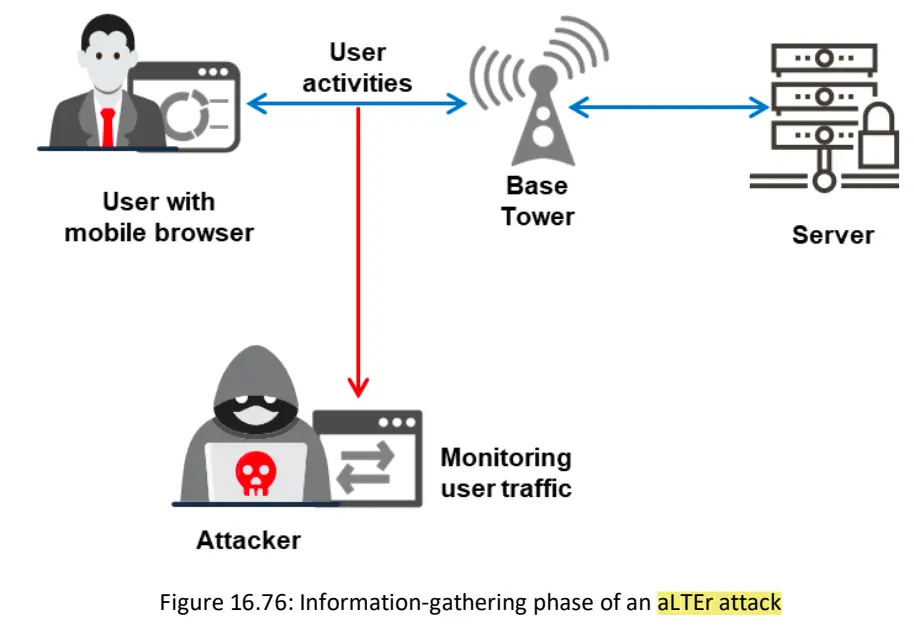
Phase 1: Information Gathering
Attackers passively collect intelligence needed for the aLTEr attack using two primary techniques:
Identity Mapping
- Attackers locate and identify target devices
- Once the target is determined, attackers plan subsequent attack phases
- This passive reconnaissance establishes the foundation for active exploitation
Website Fingerprinting
- Attackers monitor user website access patterns
- Traffic volume and access frequency are recorded
- User behavior patterns and metadata are tracked
- No data modification occurs during this phase
Phase 2: Active Attack
After gathering sufficient intelligence, attackers launch a Man-in-the-Middle (MITM) attack using their rogue base station:
- Attackers manipulate System responses to redirect victims
- Victims are directed to attacker-controlled websites
- Sensitive information (credentials, personal data) is captured
- The attack leverages the fake tower to intercept and modify traffic
Technical Details
- Target Layer: Data Link Layer (Layer 2)
- Encryption Weakness: AES-CTR mode lacks integrity protection
- Attack Vector: Rogue base station deployment
- Primary Goal: Traffic interception and redirection
- Impact: Data theft, credential harvesting, malware distribution