Cloud Computing
- Cloud Deployment Model
- Characteristics of Cloud Computing
- Limitations of Cloud Computing
- NIST Cloud Deployment Reference Architecture
- Cloud Storage Architecture
Cloud Service Types
Additional Cloud Service Models
Shared Responsibilities in Cloud
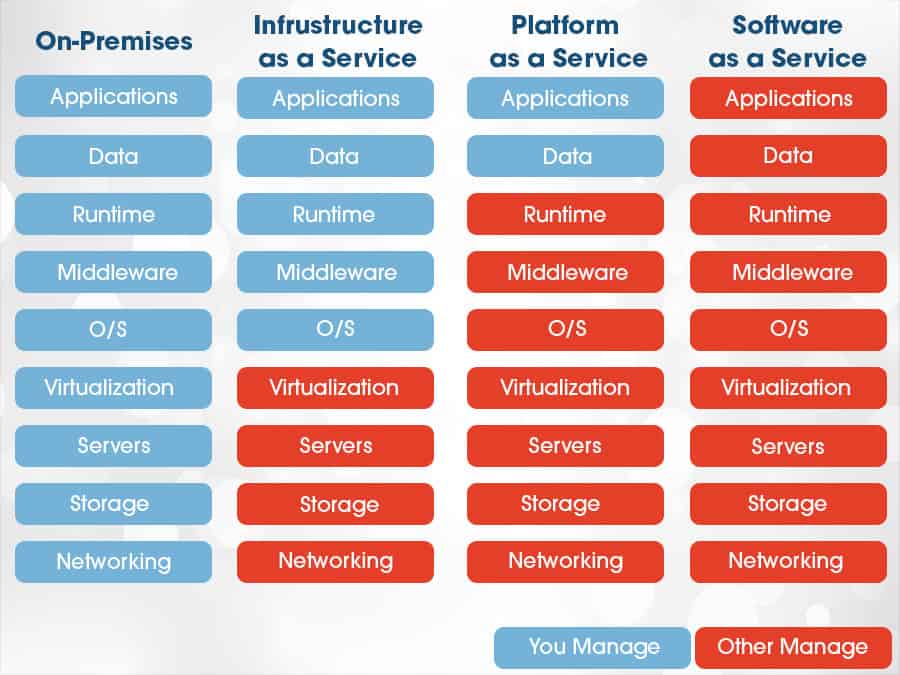
In cloud computing, the separation of responsibilities of subscribers and service providers is essential. Separation of duties prevents conflict of interest, illegal acts, fraud, abuse, and error and helps in identifying security control failures, including information theft, security breaches, and evasion of security controls. It also helps in restricting the amount of influence held by any individual and ensures that there are no conflicting responsibilities. There are mainly three types of cloud services; namely, IaaS, PaaS, and SaaS. It is essential to know the limitations of each cloud service delivery model when accessing specific clouds and their models. The figure below illustrates the separation of cloud responsibilities specific to service delivery models
Dynamic Capacity Provisioning
Elasticity vs Scalability
Scalability
- Static property
- Specifies its behavior on a static configuration.
- Handled by adding resources to existing instances - called scaling up or vertical scaling
Elasticity
- Dynamic property
- Grow or shrink infrastructure resources in an autonomic manner.
Cloud Elasticity vs. Cloud Scalability: What's the Difference? | IBM
Challenges
Engineering Challenges
- Reliability
- Migration
Live Database Migration
While being elastic, the system must also ensure that a tenant’s performance or service goals are not violated.
Live migration for the two most common cloud database
architectures:
shared disk
- Shared disk architectures are attractive for their ability to abstract replication, fault-tolerance, and consistency, as well as their support for independent scaling of the storage layer from the DBMS logic.
- Bigtable, HBase, and ElasTraS are examples.
- Shared nothing multi-tenant architecture, such as Relational
shared nothing.
Shared nothing multi-tenant architecture, such as Relational
Cloud and Cloud SQL Server, uses locally attached storage for
storing persistent data and are common in database design.
– Live migration for a shared nothing architecture requires
that all database components are migrated between nodes,
including physical storage files.
Algorithmic Challenges
- Characterizing offline optimal solutions
- Proposing online algorithm for right-sizing
- Guarantee performance in the worst case
- Nearly optimal in realistic settings.
State of the art solutions
GreenSlot
Paper: GreenSlot: Scheduling Energy Consumption in Green Datacenters
- Considered jobs with deadline requirement,
- schedules jobs to maximize green energy consumption.
- jobs may violate deadline when too many jobs are stored to execute later.
Online Resources
Distributed Databases in the cloud
See Transactions
Multitenancy
- SaaS and PaaS cloud infrastructures typically serve hundreds of thousands of small applications (called tenants)
- Dedicating a DBMS server for each tenant is often wasteful since the individual tenants’ resource requirements are often small.
- In order to reduce the total cost of operation, cloud providers typically share resources among the tenants, a model referred to as multitenancy.