Cyber Threat Intelligence
LIST
FROM [[]]
WHERE parent = this.file.link
Overview
According to the Oxford dictionary, a threat is defined as "the possibility of a malicious attempt to damage or disrupt a computer network or system." A threat is a potential occurrence of an undesired event that can eventually damage and interrupt the operational and functional activities of an organization. A threat can affect the integrity and availability factors of an organization. The impact of threats is very great and may affect the state of the physical IT assets in an organization. The existence of threats may be accidental, intentional, or due to the impact of some action.
Cyber threat intelligence, usually known as CTI, is the collection and analysis of information about threats and adversaries and the drawing up of patterns that provide an ability to make knowledgeable decisions for preparedness, prevention, and response actions against various cyberattacks. It is the process of recognizing or discovering any "unknown threats" that an organization may face so that necessary defense mechanisms can be applied to avoid such occurrences. It involves collecting, researching, and analyzing trends and technical developments in the field of cyber threats (including cybercrime, hacktivism, and espionage).
Any knowledge about threats that results in an organization's planning and decision-making to handle it is a piece of threat Intelligence. The main aim of CTI is to make the organization aware of existing or emerging threats and prepare them to develop a proactive cybersecurity posture in advance of exploitation. This process, where unknown threats are converted into possibly known ones, helps to anticipate the attack before it can happen, and ultimately results in a better and more secure system. Thus, threat Intelligence is useful in achieving secure data sharing and global transactions among organizations.
Threat intelligence processes can be used to identify the risk factors that are responsible for malware attacks, SQL injections, web application attacks, data leaks, phishing, denial-of-service attack, and other attacks. Such risks, after being filtered out, can be put on a checklist and handled appropriately. Threat intelligence is beneficial for an organization to handle cyber threats with effective planning and execution. Along with a thorough analysis of the threat, CTI also strengthens the organization's defense system, creates awareness about impending risks, and aids in responding against such risks.
Types of Threat Intelligence
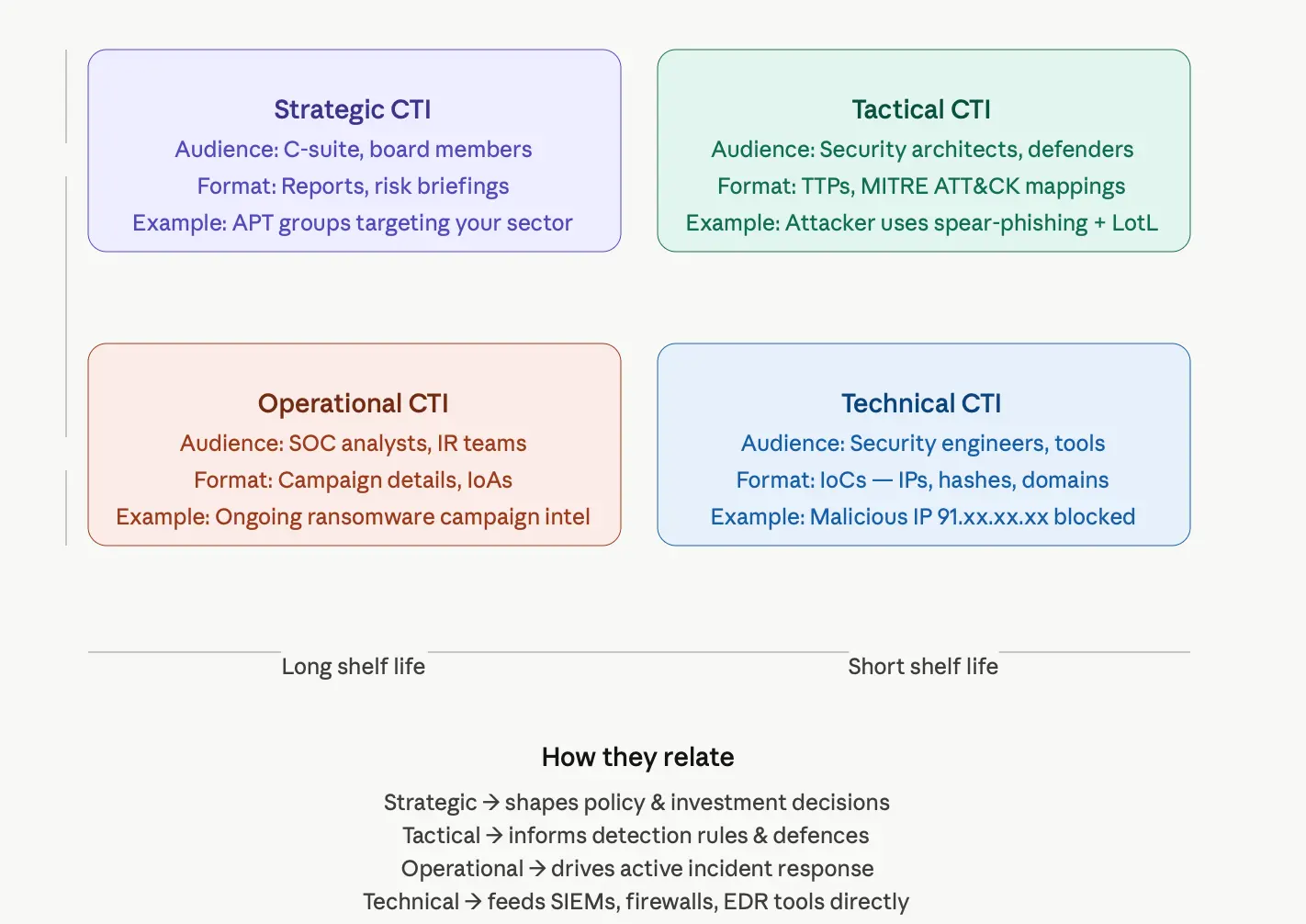
Threat intelligence is contextual information that describes threats and guides organizations in making various business decisions. It is extracted from a huge collection of sources and information. It provides operational insight by looking outside the organization and issuing alerts on evolving threats to the organization. For the better management of information that is collected from different sources, it is important to subdivide threat intelligence into different types. This subdivision is performed based on the consumers and goals of the intelligence. From the perspective of consumption, threat intelligence is divided into four different types. They are, namely, strategic, tactical, operational, and technical threat intelligence. These four types differ in terms of data collection, data analysis, and intelligence consumption.
Threat Intelligence Lifecycle
Overview
The threat intelligence lifecycle is a continuous process of developing intelligence from raw data that supports organizations to develop defensive mechanisms to thwart emerging risks and threats. The higher-level executives of the organization will provide continuous support to the intelligence team by evaluating and giving feedback at every stage. The threat intelligence lifecycle consists of five phases: planning and direction, collection, processing and exploitation, analysis and production, and dissemination and integration.
Phase 1: Planning and Direction
In this phase, proper plan is developed based on the strategic intelligence requirement, for example, what are the requirements for developing the threat intelligence, which intelligence information should be given priority, etc. This phase defines the entire intelligence program from data collection to delivery of final intelligence product and acts as a basis for the complete intelligence process. It also includes identifying the requirements of data, methods to be used to collect data, and establishing a collection plan. The requirements are set in such a way that effective and genuine intelligence data can be gathered using the constant number of resources from various open sources of intelligence (OSINT). Along with the requirements, requests are sent to collect data from various internal and external sources. During this phase, an intelligence team is formed, and their key roles and responsibilities are also formulated. Also, the planning and requirements are set for the later stages of the cycle to provide proper support for its functioning.
Phase 2: Collection
In this phase, we need to focus more on collecting the desired intelligence that is defined in phase one. The data can be collected in different ways through either technical or human means. The collection of the information can be performed directly or secretly based on the confidentiality of the information. The intelligence is collected through sources like human intelligence (HUMINT), imagery intelligence (IMINT), measurement and signature intelligence (MASINT), signal intelligence (SIGNT), open source intelligence (OSINT), and IoCs, and other third parties. This includes collecting data from critical applications, network infrastructure, security infrastructure, etc. Once the collection process is done, the data is transferred for processing in the next stage.
Phase 3: Processing and Exploitation
Until this phase, the data is not in a proper format, and it is in the form of raw data. The data obtained from previous phases is processed for exploitation and transformed into useful information that could be understood by the consumers. The raw data is converted into meaningful information by highly trained professionals using sophisticated technology and tools. This interpreted data is converted into a usable format that can be directly used in the data analysis phase. The processing to be effective requires proper understanding of the data collection plan, requirements of the consumer, analytical strategy, and types of data that are being processed. Many automated tools are used to apply data processing functions such as structuring, decryption, language translation, parsing, data reduction, filtering, data correlation, and data aggregation.
Phase 4: Analysis and Production
After processing the intelligence into a proper format, analyzing the intelligence for getting refined information is performed in this phase. The analysis includes facts, findings, and forecasts, which enable the estimation and anticipation of attacks and results. The analysis should be objective, timely, accurate, and actionable. To extract timely and accurate information, analysts need to implement four types of reasoning techniques, which include deduction, induction, abduction, and scientific method based on confidence. As the information is obtained from different sources, analysts try to combine these various sources into a single entity in this phase. The raw data is converted into information by applying various data analysis techniques such as qualitative and quantitative analyses, machine-based techniques, and statistical methods. When the analyzed information provides sufficient context for identifying a threat, then it is elevated to intelligence. This phase identifies potential threats to the organization and further helps in developing appropriate countermeasures to respond to the identified threats.
Phase 5: Dissemination and Integration
The analyzed information is then ready for the integration and distribution to the intended consumers, which is done either by automated means or by manual methods. Major threat information types that are generally used for dissemination include threat indicators, adversary TTPs, security alerts, threat intelligence reports, and tool configuration information for using tools to automate all the phases of threat intelligence. Different intelligence reports are generated to meet the requirements of the management and higher-level executives at strategic, operational, tactical, and technical levels.
Intelligence Distribution by Level
The strategic threat intelligence is consumed by high-level executives and management and focuses on high-level business strategies. The Operational is consumed by cyber security professionals such as security managers and network defenders and mainly focuses on specific threats to the organizations. The tactical threat intelligence is consumed by cyber security professionals such as IT service and SOC managers, administrators and architects and focuses on adversary's TTPs. The technical threat intelligence is consumed by SOC staff and IR teams and includes information related to the identified IoCs.
Benefits and Feedback
The disseminated intelligence helps organizations in building defensive and mitigation strategies for the identified threats. Sharing threat intelligence internally and externally helps the organizations gain situational awareness and also to enhance the current security posture and risk management processes.
This phase also provides feedback giving more inputs to the information requirements thereby repeating the threat intelligence lifecycle. The feedback is an assessment that describes whether the extracted intelligence meets the requirements of the intelligence consumer. This feedback helps in producing more accurate intelligence through relevant and timely assessments.