Internet Protocol Security
- IPSec Enumeration
- Internet Protocol Security (
IPsec) is a network security protocol that provides encryption and authentication for internet communications - It is a powerful and widely-used security protocol that provides encryption and authentication for internet communications and works by:
- encrypting the data payload of each IP packet
- adding an
authentication header(AH)- which is used to verify the integrity and authenticity of the packet
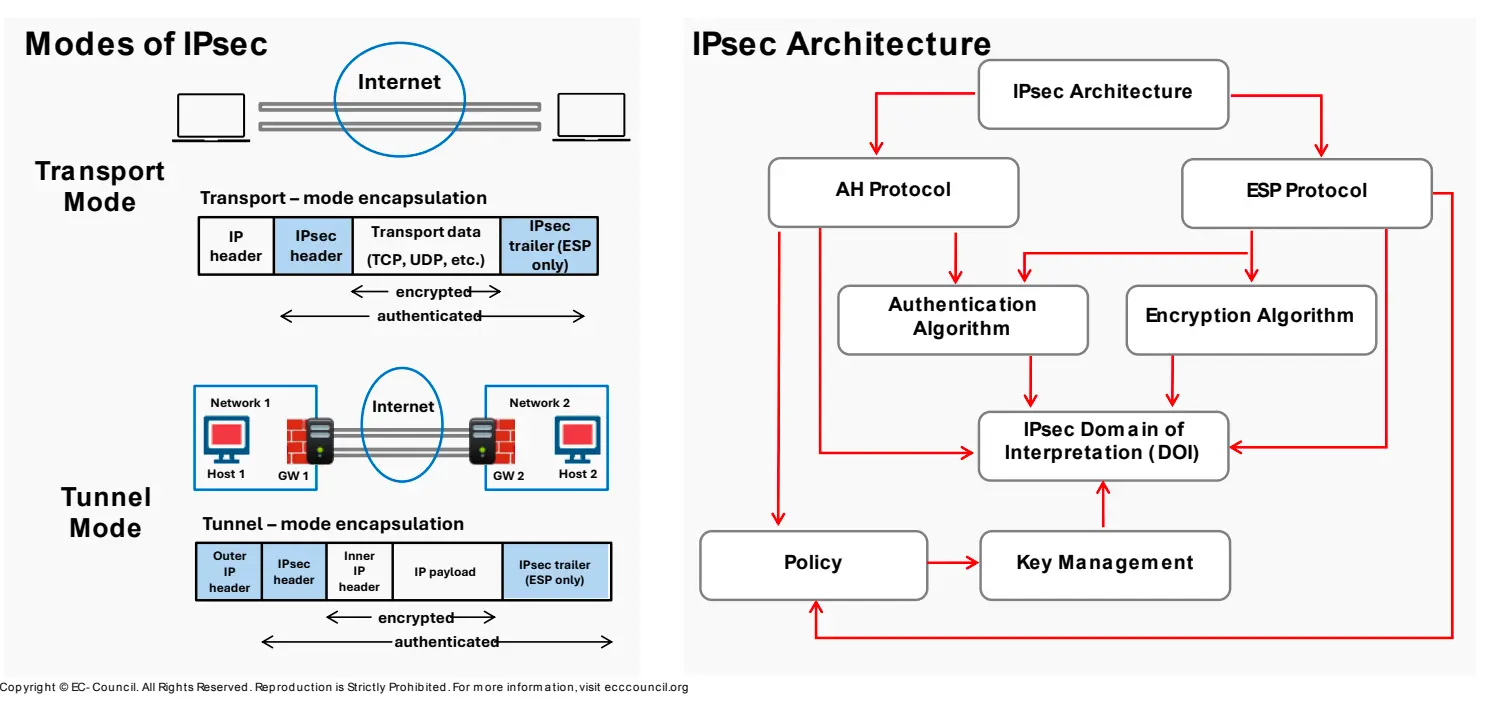
- IPsec uses a combination of two protocols to provide encryption and authentication:
Authentication Header (AH)
- This protocol provides integrity and authenticity for IP packets but does not provide encryption
- It adds an authentication header to each IP packet
- which contains a cryptographic checksum that can be used to verify that the packet has not been tampered with.
- It offers Integrity and data origin authentication, with optional anti-replay features.
Encapsulating Security Payload (ESP)
- This protocol provides encryption and optional authentication for IP packets
- It encrypts the data payload of each IP packet and optionally adds an authentication header
- similar to AH.
- It offers all the services offered by AH as well as Confidentiality.
Modes
| Mode | Description |
|---|---|
Transport Mode | In this mode, IPsec encrypts and authenticates the data payload of each IP packet but does not encrypt the IP header This is typically used to secure end-to-end communication between two hosts. |
Tunnel Mode | With this mode, IPsec encrypts and authenticates the entire IP packet, including the IP header. This is typically used to create a VPN tunnel between two networks. |
For example, an administrator could place a firewall in between. In order to facilitate IPsec VPN traffic from a VPN client outside a firewall to a VPN server inside, the firewall would need to allow the following protocols:
| Protocol | Port | Description |
|---|---|---|
Internet Protocol (IP) | UDP/50-51 | This is the primary protocol that provides the foundation for all internet communication. It is used to route packets of data between the VPN client and the VPN server. |
Internet Key Exchange (IKE) | UDP/500 | IKE is a protocol that is used to establish and maintain secure communication between the VPN client and the VPN server. It is based on the Diffie-Hellman key exchange algorithm, and it is used to negotiate and establish shared secret keys that can be used to encrypt and decrypt the VPN traffic. |
Encapsulating Security Payload (ESP) | UDP/4500 | ESP is also a protocol that provides encryption and authentication for IP datagrams. It is used to encrypt the VPN traffic between the VPN client and the VPN server, using the keys that were negotiated with IKE. |
These protocols are necessary for facilitating IPsec VPN traffic because they provide the security and encryption that are required for secure communication over the public internet. Without these protocols, the VPN traffic would be vulnerable to interception and tampering.