VLAN
A VLAN is a logical grouping of network endpoints connected to defined ports on a switch, allowing the segmentation of networks by creating logical broadcast domains that can span multiple physical LAN segments.
- With
VLANs, network administrators can segment networks based on factors such as team, function, department, or application, without worrying about the physical location of endpoints and users. - A broadcast packet sent over one
VLANdoes not reach any other endpoint that is a member of anotherVLAN. - Because each
VLANis regarded as a broadcast domain, it needs to have its ownsubnet; for example, the network administrator contracted by XQ can segment the network by departments:
| Department | VLAN ID | Subnet |
|---|---|---|
Servers | VLAN 10 | 192.168.1.0/24 |
C-Level | VLAN 20 | 192.168.2.0/24 |
Finance | VLAN 30 | 192.168.3.0/24 |
HR | VLAN 40 | 192.168.4.0/24 |
Marketing | VLAN 50 | 192.168.5.0/24 |
Support | VLAN 60 | 192.168.6.0/24 |
VLAN Identification
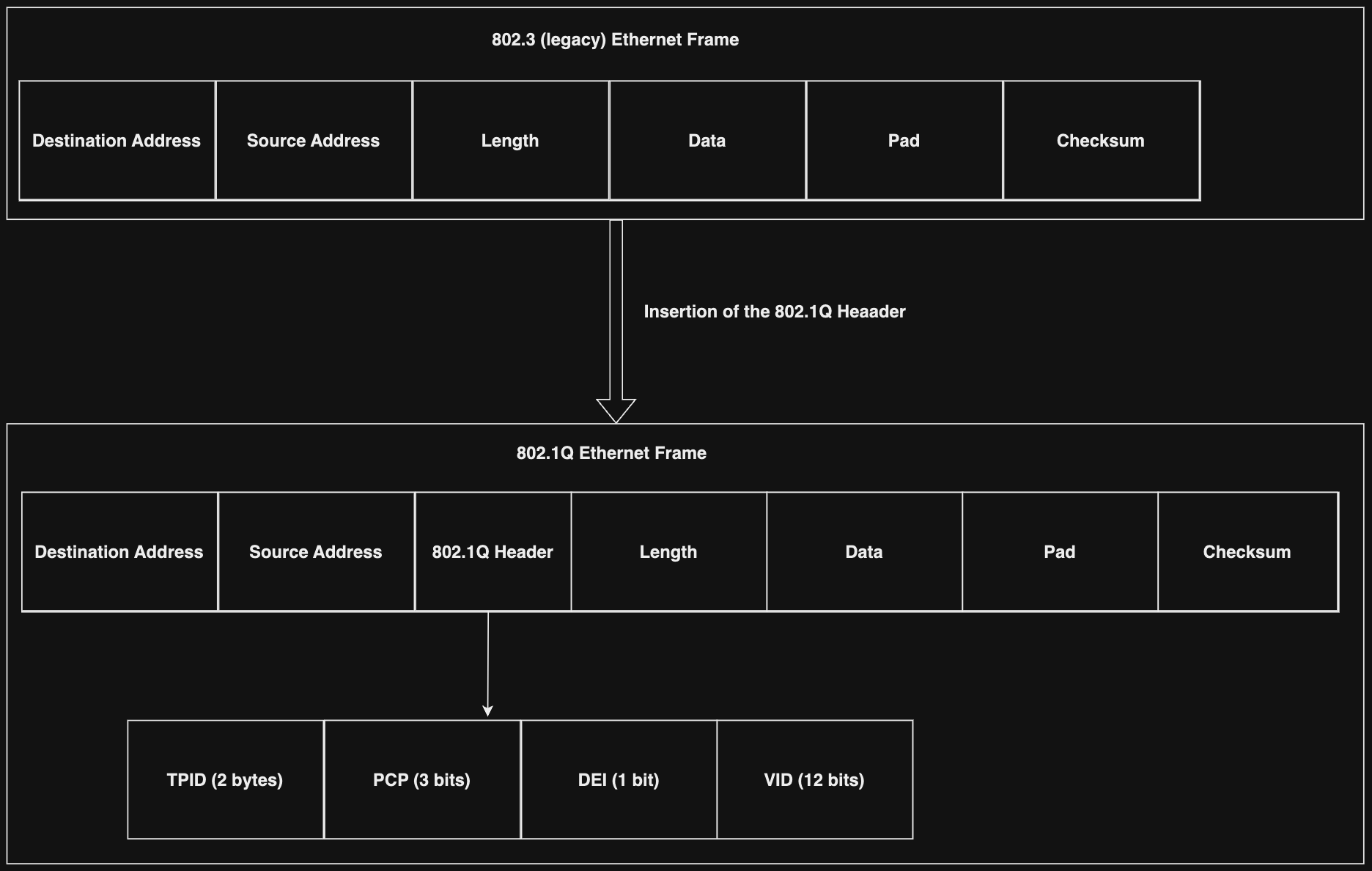
Standard 802.3 Ethernet frames do not contain VLAN information; therefore, switches and other VLAN-enabled devices need a mechanism to keep track of all the VLAN information associated with a packet while traversing VLAN-enabled devices. Two main trunking methods are utilized to achieve this, ISL and IEEE 802.1Q.
To ensure interoperability of VLAN technologies from the various network-equipments vendors, the Institute of Electrical and Electronics Engineers (IEEE) developed the 802.1Q specification in 1998.
- The
IEEE 802committee had to change the IEEE 802.3Ethernetframe format by adding a pair of 2-byte fields,TPIDandTCI(which consists of three subfields,PCP,DEI, andVID), resulting in aVLAN-compliant802.1QEthernetframe.
Assigning NICs a VLAN in Linux
sudo modprobe 8021q
lsmod | grep 8021
sudo vconfig add eth0 20