Industrial Control System
Introduction to ICS
The Industrial Control System (ICS) is an essential part of every industrial process and critical infrastructure found in industry. A typical ICS represents the information system that controls and supports all types of industrial processes, such as production, manufacturing, product handling, distribution, etc.
System Composition:
- Collection of different types of control systems and associated equipment
- Systems, devices, networks, and controls used to operate and automate industrial processes
- Components include SCADA systems, DCSs, Basic Process Control Systems (BPCSs), Safety Instrumentation Systems (SISs), HMIs, PLCs, RTUs, and IEDs
- Physical components: sensors, controllers, and actuators (mechanical, electrical, hydraulic, pneumatic)
Core Components:
- Process: Responsible for producing the output
- Control: Includes instructions needed to obtain the desired output (fully automated or with human intervention)
Operational Modes:
- Open Loop: Output depends on preconfigured settings
- Closed Loop: Output has an effect on input to acquire desired objective
- Manual Loop: System is totally under human control
Key Features:
- Multiple control loops, HMIs, and remote maintenance/diagnostics tools
- Remote management tools built using various networking protocols
- Controller maintains compliance with desired specifications
Industry Applications:
- Electricity production and distribution
- Water supply and wastewater treatment
- Oil and natural gas supply
- Chemical and pharmaceutical production
- Pulp and paper manufacturing
- Food and beverages industry
Distributed Systems:
- Physically distributed across multiple locations
- Processes may be dependent on each other
- Communication protocols used for efficient inter-system communication
!Figure 18.72: Components of an ICS
!Figure 18.73: ICS architecture
Overview
Each type of ICS works and functions differently based on the functionality and complexity of the control action. ICSs can be classified into the following types of most commonly and widely used control systems.
Types of Industrial Control Systems
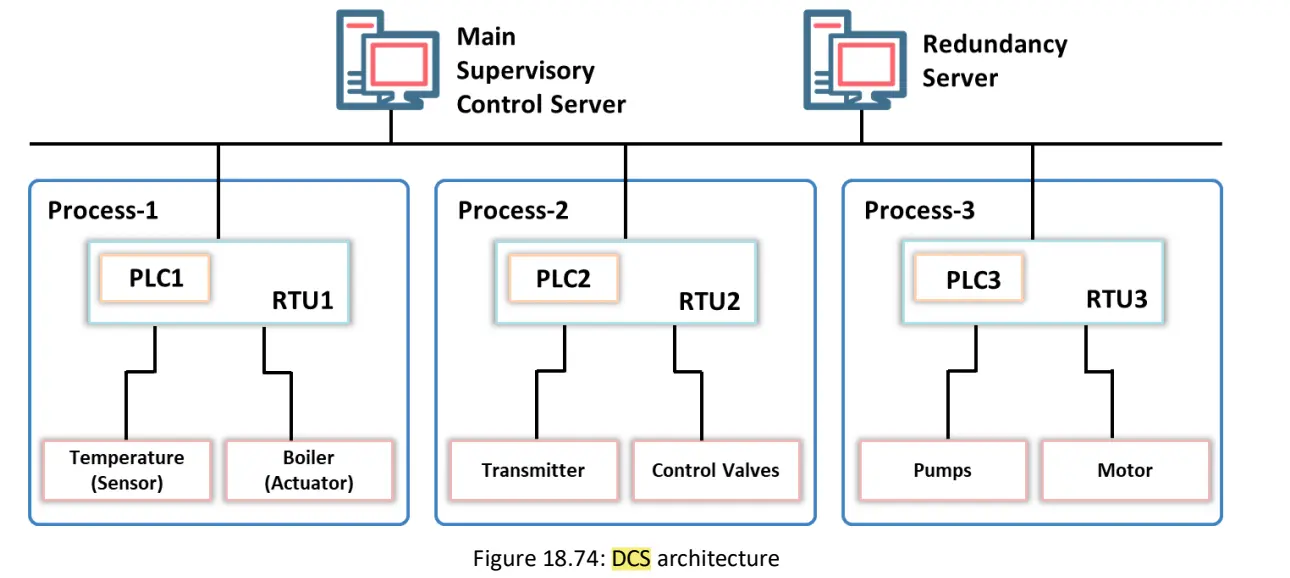
A DCS is used to control production systems spread within the same geographical location. Such systems are primarily used for large, complex, and distributed processes that are carried out in industries such as chemical manufacturing and nuclear plants, oil refineries, water and sewage treatment plants, electric power generation plants, and automobile and pharmaceutical manufacturing.
System Characteristics:
- Highly engineered and large-scale control system
- Used to perform industry-specific tasks
- Contains a centralized supervisory control unit used to control multiple local controllers
- Manages thousands of input/output (I/O) points and various field devices
Operational Features:
- Employs various feedback and feedforward loops along with key product conditions
- Uses targeted set points for process control
- Operates using a centralized supervisory control loop (SCADA and MTU)
- Connects groups of localized controllers (RTU/PLC)
- High level of redundancy at every level (I/O controllers to network level)
Advantages:
- Adaptability and flexibility in controlling distributed discrete field devices
- Scalable design (large integrated system or modular integration)
- Constant development with new technologies (wireless systems, remote transmission, data historian, embedded web servers)
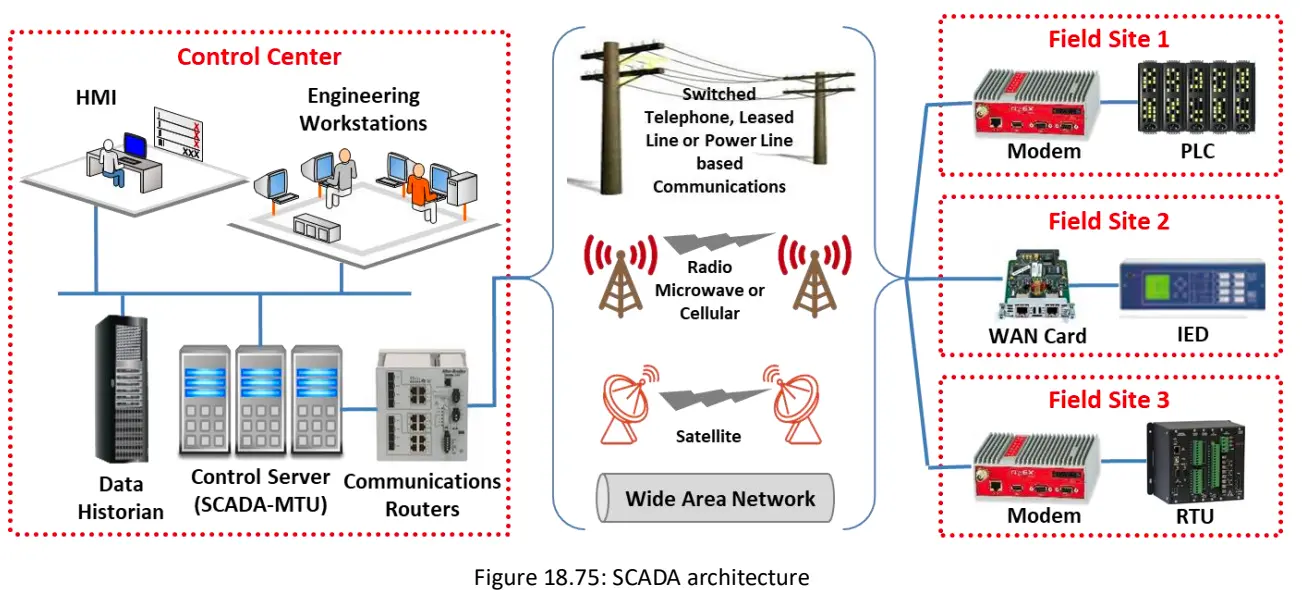
SCADA is a centralized supervisory control system that is used for controlling and monitoring industrial facilities and infrastructure. Many organizations incorporate SCADA systems for the automation of complex industrial processes, measuring trends in real time, and the detection and correction of problems.
Applications:
- Transportation of oil and gas
- Wastewater treatment and management
- Pipeline operations
- Telecommunications
- Power grids
- Building automation
- Public transportation systems
System Architecture:
- Centralized system providing supervisory control and real-time data acquisition
- Hardware and software components for data collection and transmission
- Data storage in long-term devices (data historian)
- Integration of data acquisition system with data transmission system and HMI software
Components:
- Control Server (SCADA-MTU): Processes and controls information from RTUs
- Communication Devices: Network cables, radio devices, telephone lines
- Field Sites: Geographically distributed PLCs, RTUs for equipment monitoring and control
- IEDs: Intelligent Electronic Devices with communication interfaces for sensors and equipment
Operational Features:
- Collects information from field devices and transmits to central computer
- Displays information graphically or textually to operators
- Enables real-time control and monitoring from central location
- Programmed for monitoring parameters, acceptable ranges, and response actions
- Fault-tolerant with redundant systems