Edge
Edge computing is a distributed computing model that brings data Processing and Data/Storage closer to the source of data generation, at the "edge" of the network, rather than relying solely on centralized cloud Data Centers
Edge computing
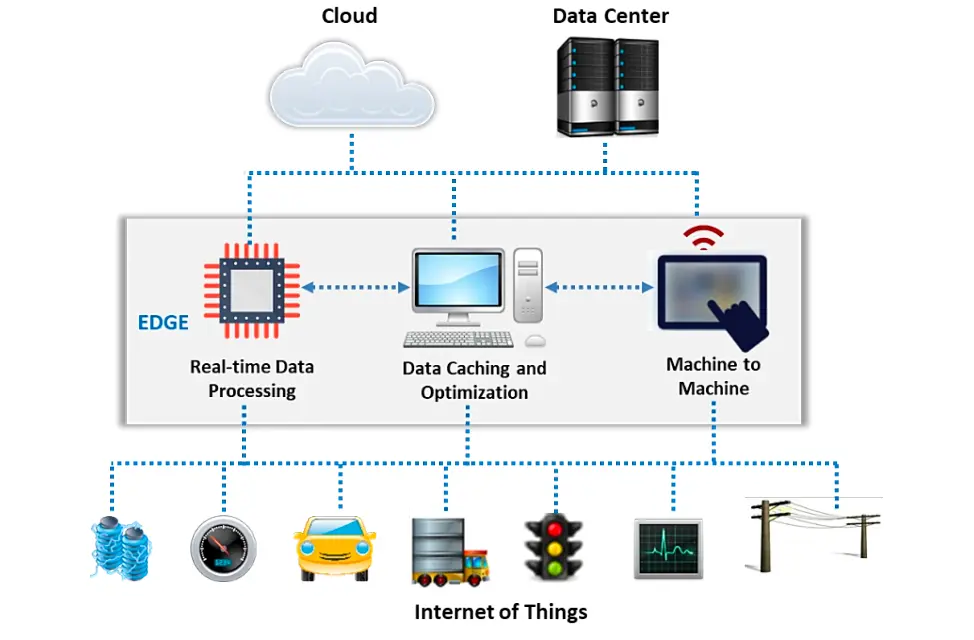
Edge computing helps the IoT environment to move computational processing to the edge of the network, allowing smart devices and gateways to perform tasks and services from the cloud end. Moving computational services to the edge of the network improves content caching, delivery, storage, and management of the IoT.
Conventional cloud computing has some issues related to data security, low performance, and increased data storage, which lead to high operational costs. These issues can be solved by replacing conventional cloud computing with edge computing. Edge computing is a subset of fog computing, and its approach to data processing is similar to that of fog computing. In fog computing, the intelligent gateway performs processing at the LAN, whereas in edge computing, the edge gateway intelligence is performed in devices such as programmable automation controllers. Edge computing is used in solutions that require the processing of small and urgent operations within a timespan of milliseconds. Edge computing is a distributed, decentralized computing model in which computation and data processing are performed close to edge devices. It stores data at locations close to the devices from which the data were collected, instead of trusting a central location to store the data. It also reduces the Internet bandwidth usage and data offload. Many organizations can utilize this technology for building automation systems for fast processing, prompt responses, and efficient real-time applications.